Friday, July 29, 2016


School Custodians Help Students through Mentoring – One at a Time


When he started his job in 2003 as a custodian, Larry Everett never dreamed that teachers and administrators would someday summon him on his walkie-talkie to rush over to a classroom because a student is shouting, throwing things, and demanding to talk with “Mister Larry.“

“Sometimes a teacher or guidance counselor will call me on my radio and ask if I don’t mind hurrying to room such and such,” says Everett. “It’s usually because there is a student with a problem who says he will only talk to me.”

In such cases, Everett is called so that a student’s anger does not escalate. Teachers and counselors at Webster Elementary School in Sumter County, Fla., also know that Everett will discretely share with them the source of the student’s discomfort.

“I keep them in the loop so we can work together and know how to deal with the issue better next time,” he says. “Teachers can have 20 or more students to look after at a time, (whereas) I can focus on one at a time.”

As with Everett, interacting with students’ daily as well as year-in, year-out, is an integral part of custodial and maintenance service work. These education support professionals (ESPs) are some of the most visible staff on campus. Given their first-name basis with students, many ESPs are eager to help students attend class regularly, get good grades, behave while on school grounds, and feel safe.

“There is a huge need to formalize these roles and include all school employees in student discipline, anti-bullying, and school safety professional development,” says Roxanne Dove, director of the NEA Education Support Professional Quality (ESPQ) Department, currently developing an ESP mentoring program geared toward local affiliates.

Already, ESPs serve the whole student by helping to keep them safe, healthy, engaged, supported and challenged, says Dove. In addition, more opportunities for ESPs to work with students are being presented through the Every Student Succeeds Act (ESSA).

“ESPQ has developed several policies to keep ESPs informed about ESSA regulations,” Dove adds. “We want to equip ESPs to advocate for their seat at the table and for students.” Recently, ESPQ established the Paraeducator Institute website which promotes professional development and leadership opportunities for Paraeducators.

The leadership training that Marie Leonard received through the Utah School Employees Association (USEA) has helped her become not only a strong advocate regarding school policies but a more informed “student cheerleader,” she says.

“We need to help students forget their stresses from home and concentrate on becoming all they can be,” says Leonard, head custodian at Mont Harmon Middle School in Price. “I love hearing about their weekend adventures, and their highs and lows.”

Students are sometimes pleasantly surprised when Leonard remembers their precise achievement level in a particular digital game they had discussed days and weeks before.

“They find it amusing that I encourage them to get to the next level in the game,” she says. “I want them to know I care.”

Melvin Bland of Goodnight Elementary School in Pueblo, Colo., says honesty is the main thing to keep in mind when mentoring students.

“Kids know when you are not being honest and that’s when you lose them,” says Bland, president of the Association of Custodial and Maintenance Employees (ACME). “When you’re genuine, they will know you care and are not just telling them anything to get rid of them,”

Bland says he sometimes stops what he is doing to sit with a student. The conversation can range from grades, tests, and homework to teachers, parents, siblings, and peers.

“It’s usually up to them what they want to get off their chest,” Bland says. “My role is to listen. Sometimes that is all they need.”

A ‘Let it Go’ Session


ACME Vice President Brian Day has mentored students for almost 10 years, as long as he has worked at the maintenance center of Pueblo City Schools, District 60.

“Many of the kids I meet at school are having problems at home and need an adult role model to listen to them without judging them,” Day says. “In some cases, their parents are not around for whatever reason, so they are looking for guidance.”

In Bland’s district, some students come from low-income, single parent or other non-traditional households. In these cases the parent or guardian might be working two jobs and not be readily available to fully support their child’s educational needs.

“Many of the kids come from broken families, or they live with their grandparents,” he says. “They may see me as someone with experience who cannot really tell them what to do but can discuss different ways to handle things.”

Bland and Day are both known to greet students in the morning before school and speak with them during classroom breaks.

“I sometimes sit with a group at lunch and have a ‘let it go session,’ as we call it,” Bland says. “I live in the same neighborhood where I work, so I see a lot of them in the grocery store and on the street. It all comes together.”

Day also meets students at lunch, sometimes treating them to a meal as appropriate.

“I don’t see anything wrong with that as long as it is all out in the open,” he says. “A lot of staff pitch-in where needed, whether it’s a teacher buying classroom supplies or support staff helping out with winter clothes or lunch tickets.”

An Untapped Resource


Some school administrators in the district, however, seem to prefer that support staff not interact with students on a personal level.

“I am not supported as a mentor in my school district,” Bland says. “A student isn’t supposed to walk up and talk to me. They were told that I am not that kind of staff.”

Day too says administrators are not as supportive as he’d like: “They don’t like us helping the kids in this way. But if I can help keep them away from drugs or other dangers just by talking with them, then I’m going to do what is right and appropriate.”

At the recent NEA Representative Assembly in Washington, delegates heard from NEA ESP of the Year Doreen McGuire-Grigg. She underscored the value ESPs bring to the lives of students.

“We are more than partners, we are problem solvers. We are an untapped resource and we are here to support the whole student, the whole school and the whole community. We are the secret weapons,” McGuire-Grigg said.

At Mont Harmon, Leonard says, “students come from all walks of life.” This circumstance demands an all-staff, student-centered system where “success is the only option.”

“All of us at school do everything we can to raise them up while we have them in our care,” says Leonard, a member of the Carbon Classified Employees Association. “It’s all hands on deck.”

The “takes a village” concept is also in place at Webster elementary where low-income, disabled, immigrant, and other historically marginalized students can be distracted from their studies due to personal circumstances.

“Sometimes the student is bullied or doesn’t take his medication or didn’t have dinner the night before because there was no dinner at their house that night,” Everett says. “I notice they are in a bad mood or looking troubled, so I ask them what the problem is … then just listen so they know we at school care about them.”


Wednesday, July 20, 2016

Congratulations to Ed Brouillette!!!!!!!!!!


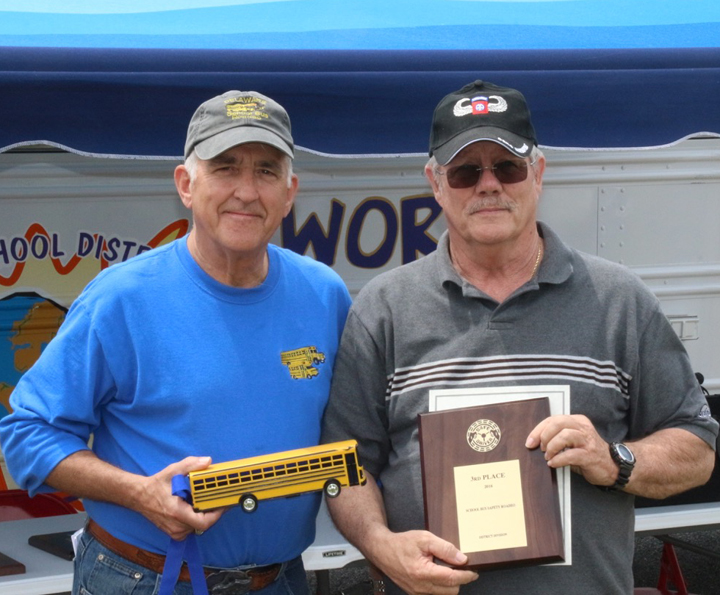
Delaware State Director of Pupil Transportation Ron Love, left, congratulates Cape Henlopen school bus driver Ed Brouillette for his success in the school bus safety competition. SUBMITTED PHOTO
June 4, 2016
A total of 13 school bus drivers competed in the 27th Annual School Bus Roadeo at Smyrna Middle School May 14. Cape Henlopen School District driver Edmund Brouillette took third place in the district category.
Cape Transportation Supervisor Lenny Richardson said, “Ed is a very professional driver, that is why we selected him as a trainer last year. He was recognized for his accomplishments at our most recent professional development day. We are all very proud of him.”
The school bus safety competition is designed to recognize excellence in school bus drivers while demonstrating skills needed in their demanding jobs. Events during the competition included: written test, bugged bus, offset alley, railroad crossing, straight line, right turn, back in to a dock, parallel park, decreasing clearance and bus stop.
Winners achieved the highest scores in their category and received plaques provided by the Delaware Association of Pupil Transportation officials. They also received annual subscriptions to School Bus Fleet Magazine and special license plates for their school buses that identify them as a category winner. Also, they are eligible to enter the 2016 School Bus Driver International Safety Competition to be held in North Carolina in July.


Way to go Ed

Tim Eitner

Friday, July 15, 2016


This article was taken from neaToday Express email dated July 13, 2016


Other Duties as Assigned

Chronic Understaffing of Public Schools Spreads Education Support Professionals Thin

It happens every day, in schools and classrooms all over the country. A paraeducator (“para”) is working one-on-one with a student—working on reading skills, helping to complete an assignment or attending to a student with severe disabilities—when a call comes in from the office that the paraeducator is needed elsewhere.

The calls are all too familiar and increasing in frequency. The para is called to "cover" for a teacher who is meeting with parents or even serve as translator for a meeting between an administrator and a parent who doesn't speak English. Paras are also called to fill in for sick teachers in the middle of the school day, proctor a test and sometimes to even transport students with special needs to another location.

Paras are not the only educators who are subject to a range of assignments under “other duties as assigned.” Education support professionals (ESP) - custodians, food service professionals, technical services and clerical service workers also are often pulled from their regular work assignments for other duties by school administrators. But this reassigning comes with a cost.

"School districts and local administrators hire paraeducators for specific purposes such as providing individual student supports within general education classrooms or running small group instruction to facilitate mastery of students' knowledge and skills," said Marilyn Likins, executive director of the National Resource Center for Paraeducators (NRCP).

Unfortunately, budget cuts, teacher and substitute shortages and increasing numbers of English language learners, are among the reasons ESP are being pulled from their regular work responsibilities to cover duties that should be assigned to full-time, permanent staff.

A Para's Struggle: School or Student?


http://www.nea.org/assets/img/content/maryannerivera-chicago-200x200.jpgMary Ann Rivera is a special education classroom paraeducator in Western Springs, Ill. As a paraeducator, every day is different for her. “I focus on helping students to be organized, engaged during discussions and work on assignments,” Rivera said. “We do a lot and it is constantly changing to meet the needs of the students we work with.”

Rivera is fluent in Spanish, and her school takes advantage of that, even though she is not a licensed translator. Her school district does have a community liaison, who is supposed to do this work, but his workload is heavy. Rivera is regularly scheduled or pulled from class, break time and even union time to translate for IEP meetings or phone calls to parents.

“It’s a difficult situation to be in because I know there is a need for translation services and no funds to hire more community liaisons,” Rivera said, “but it impacts my students when we are working one-on-one and I have to stop in order to help translate. Students with special needs demand and deserve our full attention."

Pennsbury, PA paraeducator Marla Lipkin understands the struggle between wanting to support the school, but underscores that a paraeducator's professional duties must be a priority. "Whatever duty that para is asked to do cannot be more important than her duties in regards to her students," Lipkin said. “Paras are often conflicted between what is right for their students and the task assigned by a supervisor. As professionals, our specified skill set must be respected and protected because often we’re helping our schools’ most vulnerable students.”

More Duties, More Compensation


The number of English language learners is increasing in many schools, while the number of educators assigned to work with these students is decreasing. Some unions are negotiating extra pay for ESP who have additional responsibilities, such as translating or covering classes for teachers.

Tricia DiPasquale is a special needs paraeducator and member of the Somerville (Mass.) Teachers Association (STA) bargaining team for paraeducators. "Some administrators believe we are providing a valuable service during the work day for which we are already compensated," said DiPasquale. "We know that we have many responsibilities, but how would they feel if they were depended on by an employer to do work that is far outside their job descriptions, without any type of additional compensation?"

DiPasquale said STA has bargained for contract language stating that administrators must try to identify other translation resources before pulling a paraeducator who is working with students. “But with the shortage of funds, paraeducators are still often relied on for these services.” according to DiPasquale, “We need districts to understand that chronic understaffing impacts students and paras.”

In one Chicago suburban district, paraeducators, food service and even an administrative assistant are now classified under the broad title of road heading of ‘teacher assistant’. Although some teaching assistants have been asked to voluntarily transport students, in some programs of the cooperative, the teaching assistants are now required to obtain a bus driving license and are required to transport students to and from school and to specialized programs during their school day. But according to local union president Jenn Lattimore, "they are not compensated for bus driving responsibilities during the school day because administration considers the work 'extra duties as assigned.'"

Jean Fay is a paraeducator in Massachusetts and feels that school districts often lean on paraeducators when shrinking budgets result in decreased staffing levels. For example, substitute educator pay has not kept up with inflation, meaning there are fewer available substitutes.

“School secretaries have the difficult task of trying to find coverage for the increasing number of meetings classroom teachers are required to attend, as well as identifying and assigning substitutes for staff who are on medical leave,” Fay said. "The reassignment of paras usually results in students losing much needed support. The classroom teacher is left to act as teacher and paraeducator. All the students in the class lose as a result of this horrible domino effect."

“Substitutes go through a rigorous qualification schedule and are expected to be degreed and competitive,” says Jeanette Kimber, a substitute teacher coordinator at Meadowcreek High School and Georgia Association of Educators’ ESP of the Year. “Investing in qualified substitute teachers is a must if schools are to avoid disrupting the student learning process for all students,” said Kimber. “Students should not miss a beat in their learning experiences.”

Fay sees ESP as some of the strongest advocates for the students they support every day. “I will never stop advocating for my students, whether it’s for increased funding for public education, or reminding school administrators of our responsibility to adequately support the students we work with,” Fay vowed.

Paras Need Support Too


http://www.nea.org/assets/img/content/colleenmutcherutah--tate--SPoY-200x208.jpgThe lack of qualified staff isn't the only worry that special education paraeducator Colleen Mutcher has with respect to student care. "Another concern I have is the lack of training," said Mutcher, who is the Utah School Employees Association 2016 State ESP of the Year. “The district does not provide any training for paraeducators. We work during the hours that the students are attending school and this does not allow the teacher or para time for training or collaborating. Our district is having difficulty retaining and hiring paras as many quit or choose not to return the following year.”

Likins asserts that this is no anomaly. She said paraeducators often are not provided the continuing education and professional development needed in today's changing public school environment. "To improve paraeducators' performance and enhance student outcomes, districts and schools must invest in paraeducator supports and professional development, but fail to provide the same level of training for other key members of the instructional team. Rather than recognizing the value of the paraeducator's role, they expect them to learn on the job and frequently pull paraeducators to fill gaps in staffing, which can disrupt critical student services," she said.

NEA has included NRCP as a collaborator to develop the NEA Paraeducator Institute (PI), a dynamic, paraeducator-driven resource that aims to elevate paraeducator careers through policy, professional development and resources. The PI online portal is now available and offers paraeducators, teachers and administrators a place to connect with each other, as well as access and share resources to improve paraeducator practice. “We must foster the development of paraeducators' relationships and services to students within their instructional teams. Most assuredly, improved student outcomes will follow," concluded Likins.

Despite the mounting challenges, paraeducators continue to be dedicated to students and positive about their work. Paras understand that their work is imperative to meeting the needs of the whole student - making sure each student is healthy, safe, engaged, challenged and supported.

http://www.nea.org/assets/img/content/nancyburke-paraeducator-300x226.jpgAs Haverhill, Mass. special needs paraeducator Nancy Burke said, "We do whatever is needed!" She and paraeducator Deb Tilly find prom gowns and suits, clean pants, find winter coats, mend students’ clothing, fix wheelchairs, wash/fold laundry (Haverhill High School’s special education program has a washer and dryer), staff special student events, write grant proposals and more. “The list is long, but whatever it is, education support professionals just do it for their students,” Burke declared. “We love what we do every day!”


Wednesday, July 13, 2016

Memorial Service for Ed Murauskas


Dear CHSSA members;

Last month I inform you of the recent passing of Ed Murauskas. As many of you know Ed was the past President of CHSSA. Thanks to Lisa, I have received some updated information pertaining to Ed’s memorial service.


Captain E. A. Murauskas’s ashes will be interred at Arlington National Cemetery in early 2017 by the United States Marine Corps. The family will have a memorial service on Saturday July 16, at the Long Neck Chapel of Melson Funeral Services, 32013 Long Neck Road, Millsboro. Stop by any time between 10 a.m. and noon to pay your respects.

 Tim Eitner

President of CHSSA